



Healthcare Reputation Management: A Practical Guide to Reviews, Patient Feedback, and Trust
A clinic can deliver excellent care and still leave prospective patients uncertain. An outdated doctor profile, unanswered review, inconsistent opening hours, or confusing appointment process can weaken confidence before a patient speaks to the…
A clinic can deliver excellent care and still leave prospective patients uncertain. An outdated doctor profile, unanswered review, inconsistent opening hours, or confusing appointment process can weaken confidence before a patient speaks to the team.
Healthcare reputation management is the coordinated process of monitoring public feedback, maintaining accurate information, responding responsibly, and improving the experiences behind a healthcare organisation’s reputation. It connects communication with operations: the booking team, clinical leadership, and marketing team each influence what patients see and experience.
For clinics in the UAE, the objective should be a credible, consistent picture of the organisation across English and Arabic touchpoints. A strong reputation programme helps patients understand who provides care, where services are available, and how concerns are handled.
Start by Auditing What Patients Can Actually Find

Search for the clinic name, individual doctors, and each location. Review the website, Google Business Profiles, relevant directories, and active social accounts from a prospective patient’s perspective.
Check whether the same facility name, phone number, address, and opening hours appear everywhere. Verify that doctor biographies reflect current roles and credentials, and that service descriptions match what the clinic currently provides.
Record problems in a simple action register:
| Finding | Patient concern | Responsible owner |
| Different opening hours across profiles | Can I visit at this time? | Location manager |
| Doctor listed at an outdated branch | Where can I book this specialist? | Practice administrator |
| Unclear appointment instructions | What should I do next? | Booking team |
| Repeated complaints about callbacks | Will anyone respond? | Operations manager |
Fix access and identity errors before launching a larger review campaign. Asking more people to review an unreliable booking experience can simply make the underlying problem more visible.
Give Every Review a Clear Response Route
Assign responsibility for checking reviews and public mentions. A marketing coordinator may monitor channels, while a practice manager approves routine responses and clinical leadership handles concerns involving care.
Separate feedback into three practical categories:
- Routine experience feedback: parking, directions, reception, or scheduling.
- Service recovery concerns: missed callbacks, billing questions, or repeated administrative problems.
- Sensitive concerns: allegations involving clinical care, confidentiality, or patient safety.
Each category needs an owner and an escalation path. A response target can be useful, but it should reflect staffing and approval requirements rather than encourage rushed replies.
Keep a private record of the issue, referral to the relevant team, follow-up status, and operational action. Public response speed alone does not show whether a concern was resolved.
Respond to Negative Reviews Without Exposing Patient Information

A public response should acknowledge the concern and explain a private route for discussion. Avoid debating a diagnosis, disclosing appointment details, or confirming the reviewer’s patient status.
For an administrative complaint, a neutral response could read:
- Thank you for sharing your concern. We take feedback about communication seriously. Please contact our practice manager through our official phone number so the appropriate team can review the matter privately.
Adjust the wording to the issue instead of posting the same message repeatedly. Do not promise a particular resolution before the authorised team has investigated.
A positive response also needs care. Thank the person without repeating treatment information they chose to include in their review. Their public disclosure is not an invitation for the clinic to add further details.
Request Honest Reviews Through a Consistent Process
Google’s Maps contribution policy prohibits incentivised reviews, discouraging negative feedback, and selectively requesting positive reviews. Requests must not pressure people or dictate review content.
Use a neutral invitation and a consistent eligibility process. Do not screen patients by satisfaction score before offering the public review link, and do not offer discounts or gifts for reviews.
A suitable invitation is:
- If you would like to share your experience, you can leave an honest review using this link. Please avoid including medical or personal information you would prefer to keep private.
Keep participation optional and use a communication channel approved by the clinic. Avoid staff review quotas and requests to mention a particular employee. The objective is authentic feedback, not a manufactured rating.
Treat Feedback as Operational Evidence
Read reviews alongside private complaints, reception feedback, and booking records. Look for recurring themes rather than reacting only to the loudest comment.
For example, several comments about waiting may point to unclear expectations, scheduling pressure, or inconsistent updates. Marketing can explain the appointment process more clearly, but operational leadership must investigate the actual delay.

An illustrative improvement cycle might be:
- Identify recurring complaints about unanswered calls.
- Compare them with missed-call and callback records.
- Assign ownership for returning calls during staffed hours.
- Publish accurate contact and availability information.
- Review whether the same complaint continues to appear.
This is a proposed workflow, not an ICONCLY client case study. Its purpose is to show how feedback can lead to a measurable service improvement.
Connect Reputation With Verifiable Website Information
Reviews should sit alongside accurate doctor profiles, clear service pages, accessible contact information, and a realistic explanation of the consultation process. They cannot establish clinical outcomes or substitute for professional credentials.
Support patient understanding by publishing:
- Current physician qualifications and areas of practice.
- Facility and location information.
- Clear service availability and appointment routes.
- Clinically reviewed educational content with a genuine review date.
- Practical answers to questions about preparation and access.
Medical SEO for doctors can help connect this information with relevant searches. Reputation management then supports the confidence patients need after discovering the clinic.
For organisations with several branches, use shared response principles while keeping each branch’s details and feedback distinct. A strong overall rating should not conceal a persistent issue at one location.
Measure More Than the Average Star Rating
Use a monthly dashboard that combines public signals with service improvement:
| Metric | What it helps assess |
| New review volume and recency | Whether feedback is current |
| Median response time | How consistently feedback is acknowledged |
| Repeated complaint themes | Which problems remain unresolved |
| Escalated cases closed | Whether follow-up reaches completion |
| Accuracy issues corrected | Whether public information improves |
| Qualified enquiries from relevant channels | Whether visibility supports useful contact |
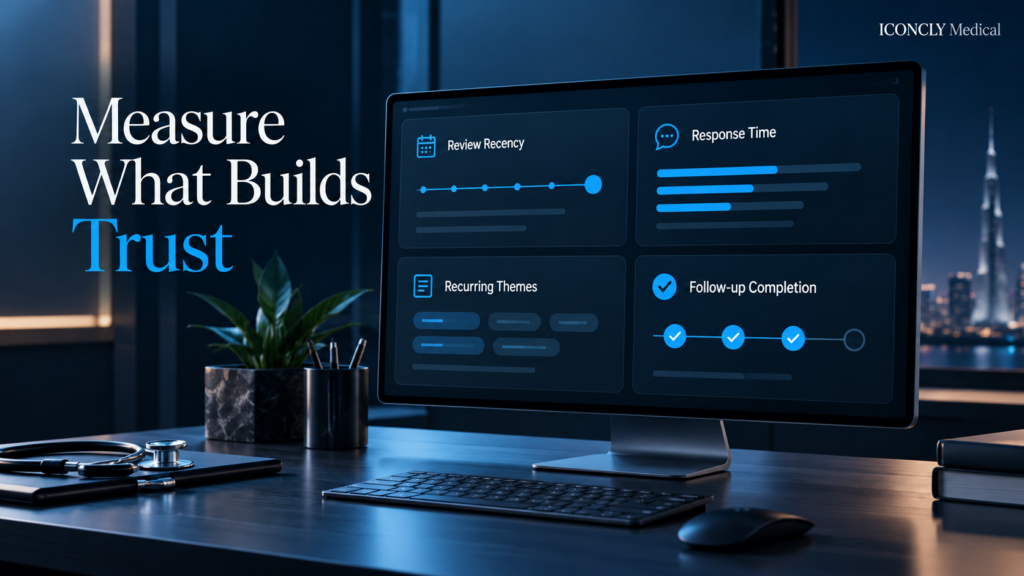
Review these measures by location and over time. An increase in bookings after profile improvements may be encouraging, but it does not prove that reputation work caused the increase. Seasonality, advertising, availability, and other changes can influence results.
A Practical First-Month Plan
Week one: audit public profiles, correct important errors, and document review access and ownership.
Week two: establish response templates, escalation rules, and a privacy-aware approval process.
Week three: introduce an optional, neutral review invitation and examine recurring feedback themes.
Week four: implement one operational improvement and create a baseline dashboard for the next reporting period.
Start with a system the team can maintain. Expanding monitoring across more channels makes sense only when somebody can act on the findings.
Connect Reputation With the Five Core Marketing Services
Reputation becomes more useful when patients encounter consistent information across the full digital journey. Each of ICONCLY Medical’s core services has a distinct supporting role:
- SEO for doctors helps prospective patients discover accurate service and professional information through relevant searches.
- Doctor website design gives that information a clear home, with credible profiles, practical location details, and accessible enquiry routes.
- Personal branding for doctors helps communicate a physician’s verified expertise consistently across public touchpoints.
- Social media for doctors supports ongoing education and professional communication, with appropriate review and moderation.
- PPC for doctors brings relevant searchers to approved service pages where they can evaluate the provider before making contact.
These services support visibility and communication; the clinic’s real service quality and handling of concerns remain central to its reputation.
Frequently Asked Questions
What is healthcare reputation management?
It is the ongoing management of public information, reviews, feedback, and responses, supported by improvements to the patient experience. It involves both communication and operational accountability.
Can a clinic remove a negative Google review?
A clinic can report a review it believes violates platform rules. A negative opinion alone is not a reason for removal, and reporting does not guarantee that Google will remove it.
Should a clinic reply to every review?
A consistent response process is useful, provided replies protect privacy and sensitive concerns receive appropriate review. Responses should be proportionate to the feedback.
How quickly can reputation management improve results?
Accuracy and response processes can improve once changes are implemented. Patient confidence, review patterns, and commercial outcomes need continued observation; no fixed timeframe or booking increase should be guaranteed.
Build a Reputation Programme Your Team Can Support
ICONCLY Medical helps healthcare organisations connect digital authority with clear patient journeys. A diagnostic review can identify gaps in public information, search visibility, and the way prospective patients move towards an enquiry.
Explore ICONCLY’s solutions for clinics to discuss how reputation, visibility, and patient communication can work together.