



Patient Acquisition: How to Build a Measurable Growth Strategy for Your Clinic
A clinic may receive website visits, phone calls, and social media messages without knowing which activity leads to new patients. When every interaction is reported as a conversion, marketing can appear successful even while…
A clinic may receive website visits, phone calls, and social media messages without knowing which activity leads to new patients. When every interaction is reported as a conversion, marketing can appear successful even while appointment requests go unanswered or booked patients do not attend.
Patient acquisition is the process of helping prospective patients discover an appropriate healthcare provider, understand its services, make contact, and attend an initial appointment. It combines visibility, credibility, access, and the clinic’s ability to handle enquiries effectively.
A measurable patient acquisition strategy starts with a specific service and follows the pathway from first discovery to an attended appointment. For UAE clinics, that pathway should account for location, language, service availability, and how patients prefer to contact the organisation.
Define the Service Before Choosing the Marketing Channel
“We need more patients” is too broad to guide investment. Define which service needs appropriate new demand, who provides it, where it is available, and whether the clinic can support additional appointments.
Answer five questions:
- Which clinical service is the growth priority?
- Which patient needs does that service address?
- Which doctor and location provide it?
- What information is needed before an appointment request?
- How much appointment capacity is available?
Clinical teams should define suitability and eligibility. Marketing should communicate the approved scope accurately rather than decide who needs a treatment.
If a specialist is available at only one branch, campaigns and service pages should make that location clear. If scheduling requires a referral or preparation, explain the next step before collecting an enquiry.
Map the Full Patient Acquisition Journey
Use separate stages so the team can identify where progress stops:
| Stage | Example action | Meaning |
| Discovery | Relevant search visit | A prospective patient finds the clinic |
| Evaluation | Service and doctor profile views | The visitor explores suitability and credibility |
| Enquiry | Submitted request or connected call | The person makes contact |
| Booking | Appointment confirmed in the clinic system | A time is arranged |
| Attendance | First appointment attended | A new patient reaches care |
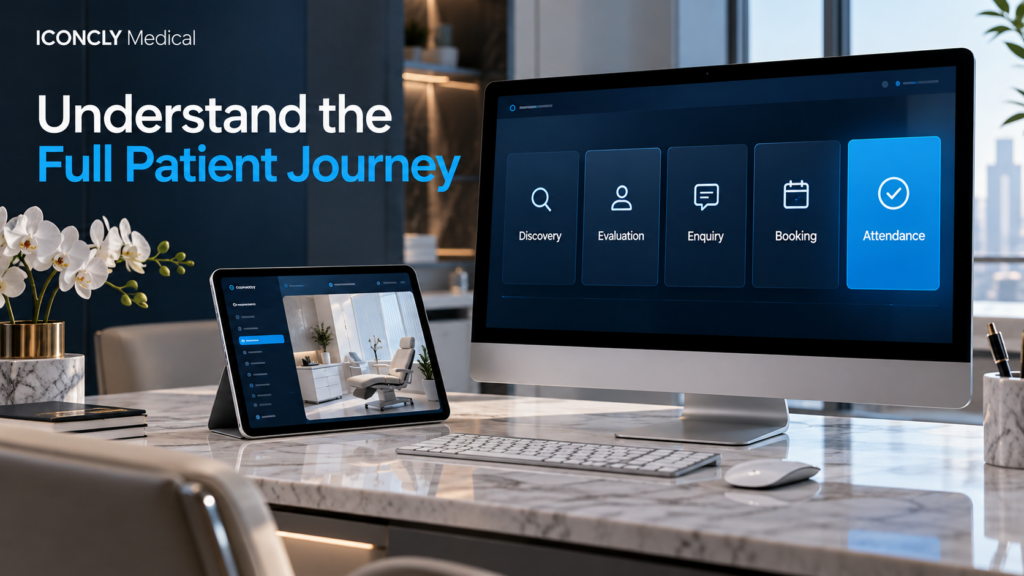
A call-button click is an intent signal, not proof of a connected call. A WhatsApp click does not confirm that a conversation took place. A submitted form is not a confirmed booking.
This distinction lets a clinic investigate the right issue. Strong enquiries with weak booking rates may indicate availability or response problems. Strong bookings with weak attendance may indicate appointment communication or scheduling difficulties.
Match Each Channel to a Specific Role
Organic Search: Answer Relevant Patient Questions
Use clear service pages, doctor profiles, and educational content to support discovery and evaluation. Match the page to the search: a treatment question needs a useful explanation, while a location-specific query needs accurate local availability.
SEO for doctors should connect clinical expertise with relevant demand. Reporting should include the services and locations attracting useful enquiries, rather than only total traffic.
Local Search: Make Access Clear
Maintain accurate location profiles, contact details, opening hours, and directions. Review whether each branch links to the correct location page and appointment route.
For a multi-location clinic, avoid directing every local visitor to a generic homepage that requires them to search again for their branch.
Paid Search: Capture Relevant Active Demand
Paid search can support a defined service when the landing page, appointment capacity, and enquiry response process are ready. Organise campaigns around appropriate searches and exclude clearly irrelevant queries.
Check the service’s advertising eligibility and targeting before launch. Google’s healthcare advertising policy applies restrictions to certain categories, and its health-related personalised advertising policy limits advertiser-created audiences for sensitive categories.
PPC for doctors should therefore be planned around the actual service and permitted targeting, not a generic remarketing template.
Social Media: Support Understanding and Familiarity
Use social content to explain expertise, common consultation questions, and service access. Give interested viewers a relevant destination where they can find more detail and contact the correct team.
Social activity does not need to generate an immediate booking to be useful, but claims about its contribution should be supported by evidence.

Improve the Enquiry Experience Before Increasing Spend
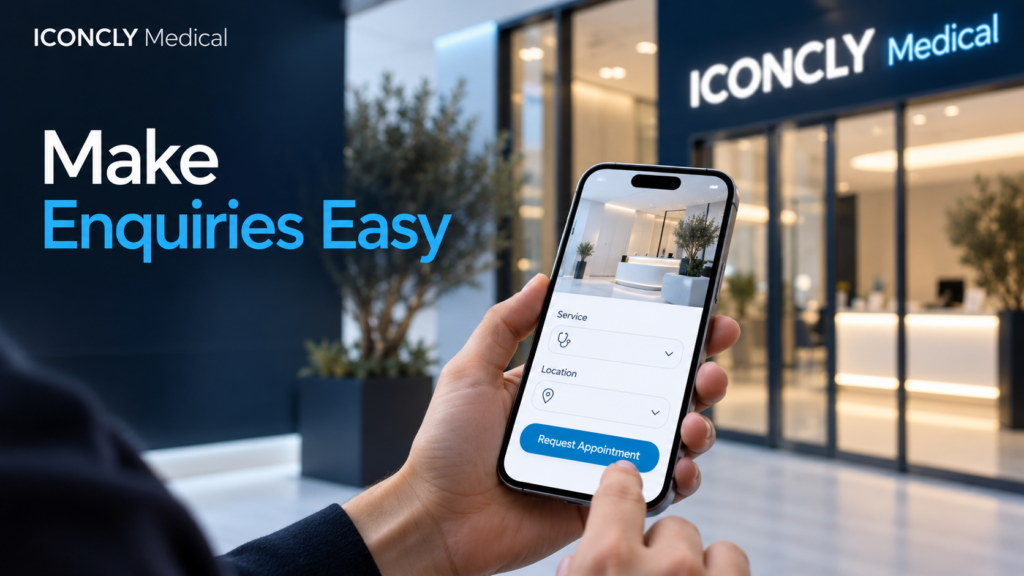
Test the contact process on a mobile phone. Can a visitor identify the right service, find the relevant location, and understand what happens after requesting an appointment?
Useful improvements include clear contact options, short forms, accurate availability information, and a confirmation message that explains the next step. Ask for the minimum information needed to route the request; detailed clinical histories belong in the approved clinical process.
For bilingual audiences, provide Arabic and English journeys that preserve the same service meaning. Check the confirmation message and follow-up route as well as the main page.
Assign each enquiry to a responsible team. A missed call or unread message is an operational task, not simply a marketing statistic.
Build Measurement Around Real Appointment Outcomes
Use website analytics for appropriate interaction signals and the clinic’s authorised booking system for confirmed appointments and attendance. Connect reporting through a privacy-reviewed process, using aggregated outputs where possible.
Google’s Analytics privacy guidance prohibits sending personally identifiable information to Analytics. Review page URLs, event parameters, and form tracking for accidental exposure of names, emails, or other identifying details. Do not include diagnoses, clinical notes, or form answers in routine marketing events.
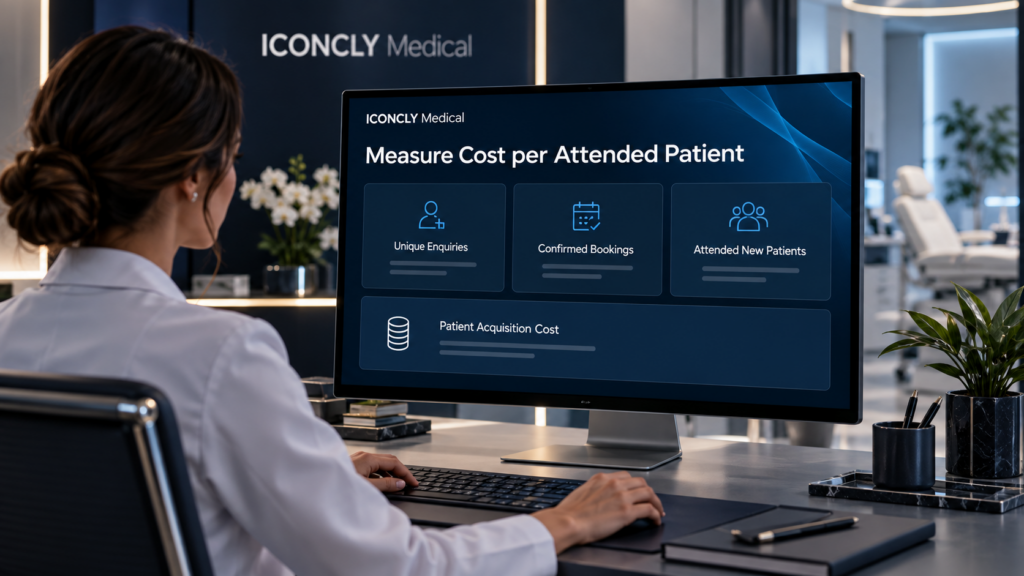
A compact dashboard can track:
- Unique relevant enquiries, with duplicates removed.
- Enquiry-to-booking rate.
- Booking-to-attendance rate.
- Median response time during staffed hours.
- Cost per attended new patient, where attribution is reliable.
Define denominators and reporting periods consistently. Where appointments happen later, allow enough time for the enquiry cohort to mature before comparing performance.
Calculate Patient Acquisition Cost Without Inflating Success
Patient acquisition cost is the acquisition expenditure allocated to a defined group divided by the number of attended new patients attributed to it.
For example, an illustrative campaign spends AED 6,000 and generates 80 unique enquiries, 40 confirmed bookings, and 30 attended first appointments. Its media-only costs are:
| Outcome | Calculation | Cost |
| Enquiry | AED 6,000 ÷ 80 | AED 75 |
| Confirmed booking | AED 6,000 ÷ 40 | AED 150 |
| Attended new patient | AED 6,000 ÷ 30 | AED 200 |
These numbers are hypothetical, not UAE benchmarks or promised results. They exclude management fees, creative production, and other acquisition costs. Include those costs when reporting a broader acquisition cost, and label the scope clearly.
Prioritise the Bottleneck You Can Demonstrate
If relevant visitors rarely enquire, examine service clarity, credibility, and contact usability. If enquiries rarely become bookings, investigate response handling, availability, and expectation setting. If bookings rarely become attendance, review confirmation and reminder processes through approved channels.
Improve one identifiable problem before expanding all channels at once. Record what changed and compare appropriate periods while accounting for seasonality and shifts in appointment capacity.
Connect the Five Services Around One Appointment Journey
An acquisition programme needs a clear role for every service. SEO for doctors supports relevant discovery, while PPC for doctors can capture approved search demand for services ready to receive enquiries.
Doctor website design connects those visits with clear service information, mobile usability, and appropriate appointment requests. Personal branding for doctors helps patients understand the clinician’s verified expertise before they decide to contact the practice.
Social media for doctors supports education and familiarity between discovery and contact. The mix should follow the diagnosed gap: a clinic with strong visibility but poor enquiry handling may need to improve the journey before expanding promotion.
Frequently Asked Questions
How is patient acquisition different from lead generation?
Lead generation usually measures contact or expressed interest. Patient acquisition follows that interest through booking and an attended initial appointment.
Which patient acquisition channel is best for a clinic?
The answer depends on the service, local demand, budget, and operational readiness. Use evidence from relevant enquiries and appointment outcomes rather than assuming one channel is always best.
Can organic and paid search work together?
Yes. They can support different parts of a service’s search demand, provided campaigns and pages have clear roles and reporting avoids counting the same outcome twice.
Should every service receive equal marketing investment?
No. Prioritise services based on appropriate demand, capacity, strategic importance, and the clinic’s ability to provide a clear patient journey.
Identify Where Your Clinic Is Losing Appointment Opportunities
ICONCLY Medical starts with diagnosis: how patients find the organisation, what they understand, and where the journey towards an enquiry becomes difficult.
Explore ICONCLY’s clinic growth solutions to discuss a patient acquisition strategy that connects visibility, communication, and measurable appointment outcomes.