


Healthcare Social Media Marketing: From Content Planning to Patient Enquiries
A full posting calendar does not necessarily mean a clinic has a social media strategy. Content may attract attention while leaving important questions unanswered: what does the clinic provide, who delivers the care, and…
A full posting calendar does not necessarily mean a clinic has a social media strategy. Content may attract attention while leaving important questions unanswered: what does the clinic provide, who delivers the care, and how can an interested person reach the right team?
Healthcare social media marketing is the planned use of social platforms to communicate accurate health information, explain professional expertise, and support appropriate contact with a healthcare organisation. Its value depends on the connection between content, patient understanding, and the next step available to the audience.
For UAE clinics, an effective programme needs clear service priorities, language choices, clinical review, and a reliable enquiry process. These foundations make content useful beyond the moment somebody watches a video or likes a post.
Choose the Patient Journey You Want to Support
Start with a defined service or department rather than a list of trending formats. Identify what people need to understand before they contact that team.
A specialist clinic might need to explain what happens during an initial consultation. A diagnostic centre may need to clarify preparation and access. A medical group may need to help patients distinguish between branches and specialties.
Write one practical objective for the content programme. For example:
Help prospective patients understand the consultation process for the selected specialty and find the correct appointment route.
This is clearer than an objective to “increase engagement.” It also tells the writer, clinician, designer, and booking team what the content should achieve together.
Define Who the Content Is For
Use information from reception teams, common patient questions, website searches, and approved audience research to understand communication needs. Avoid building targeting or messaging around assumptions about an individual’s health condition.
Consider language, familiarity with the service, preferred content format, and the practical questions that may delay contact.
For an Arabic and English programme, preserve clinical meaning in both languages while adapting phrasing naturally. Check subtitles, graphics, captions, and landing pages. A bilingual caption does little to improve access if the linked appointment page is difficult to use in the reader’s language.
Build Four Content Pillars With Distinct Jobs
| Content pillar | Question it answers | Suitable format |
| Patient education | What should I understand about this service? | Clinician-reviewed explainer |
| Professional expertise | Who provides care and what is their scope? | Doctor introduction or interview |
| Consultation process | What happens when I contact or visit the clinic? | FAQ carousel or walkthrough |
| Service access | Where is it available and how do I enquire? | Location post or appointment guide |
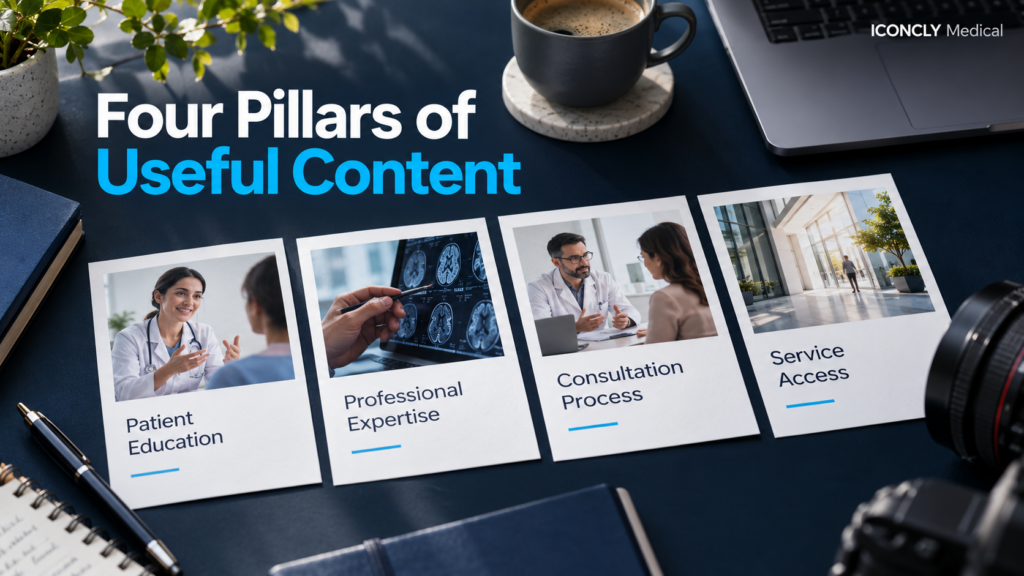
Education should explain rather than diagnose. Expertise content should use verifiable credentials. Process content should describe the clinic’s real workflow, and access posts should link to the correct branch or service.
This structure helps prevent a calendar dominated by promotions. It also keeps each post connected to a practical audience need.
Plan a Calendar the Clinical Team Can Review
Start with a manageable publishing pace. The right frequency is the one the organisation can sustain with accurate content, timely review, and attentive moderation.
An illustrative four-week sequence for one priority service could be:
| Week | Main asset | Supporting asset | Destination |
| 1 | Doctor explains the service’s scope | FAQ on common consultation questions | Service page |
| 2 | Consultation preparation carousel | Branch access and contact details | Location page |
| 3 | Interview addressing a common misconception | Summary with evidence source | Educational page |
| 4 | Walkthrough of the appointment process | Questions to ask during a consultation | Appointment enquiry route |
The sequence is a planning example, not a guaranteed performance formula. Change the balance according to audience questions, clinical priorities, and what the team can produce responsibly.
Use a Documented Approval Workflow
Give each asset an owner, source record, clinical reviewer, approval status, and publication date. Verify claims before design and filming, so the production team does not build an entire asset around unsupported wording.
A practical workflow is: brief, draft, clinical review, language review, visual review, approval, publication, and monitoring.
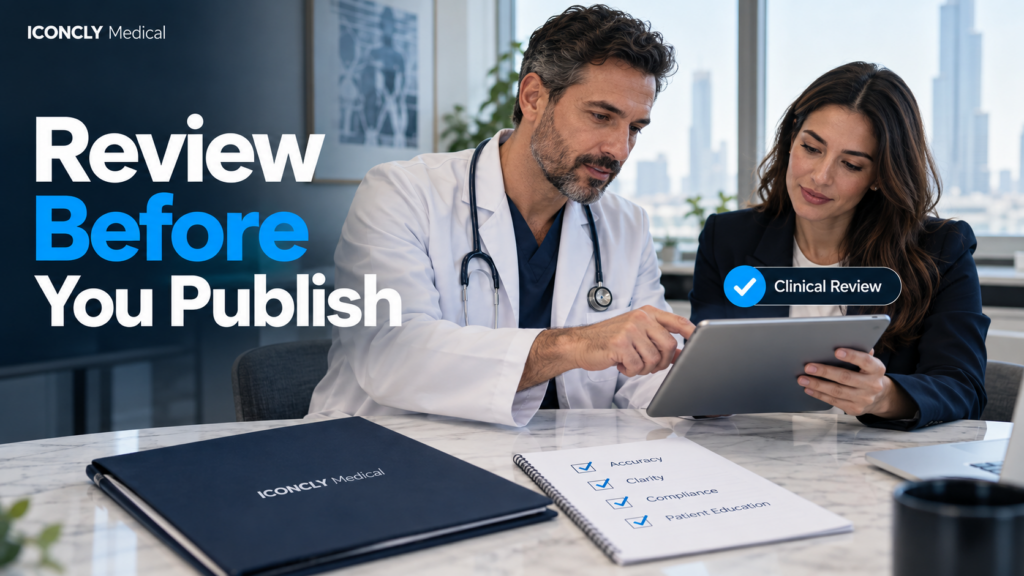
Dubai’s DHA standards for social media medical advertisements address consent and misleading claims. DHA also issued a social media health advertising circular in August 2025. Facilities should check the applicable authority’s current requirements when approving content.
Avoid guarantees, fear-based messages, or comparisons that lack appropriate evidence. Patient participation should go through the organisation’s documented consent and approval process; consent alone does not make every proposed advertisement appropriate.
Review older posts when service availability, staff, or guidance changes. An outdated post can continue circulating after the original campaign ends.
Give Each Post One Useful Next Step
Match the call to action to the reader’s stage of understanding. An educational post can invite readers to explore a reviewed explanation. A consultation guide can direct them to preparation details. A service-access post can offer an appointment enquiry.
Avoid sending every post to the homepage. A dedicated page should continue the same subject and identify the relevant doctor, location, and contact route.
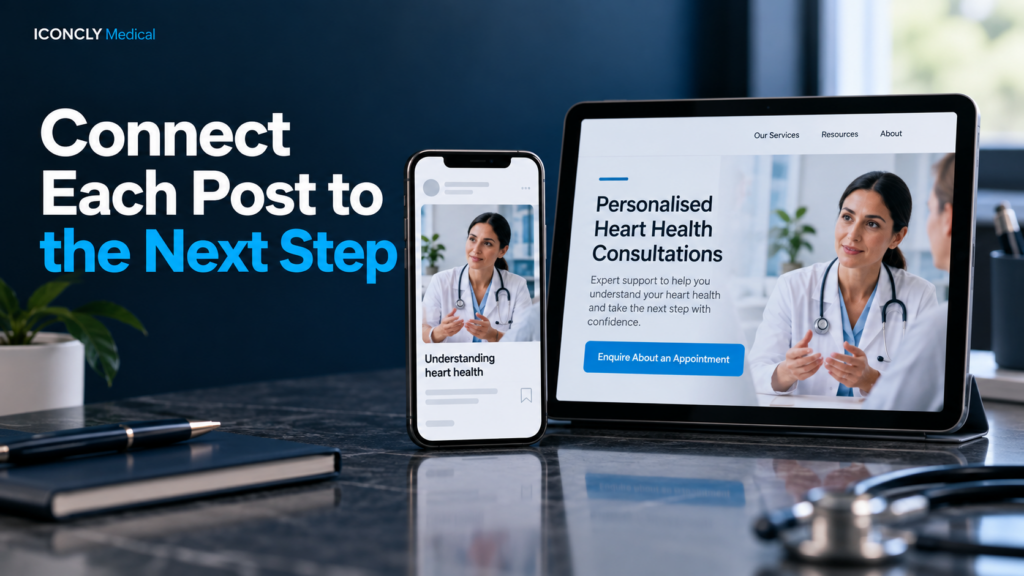
Use campaign tags for attribution where appropriate, without including patient identifiers or sensitive information. Keep the link readable and test the destination on mobile.
ICONCLY’s social media service for doctors connects professional positioning with patient communication. At clinic level, those communications also need consistent service and branch information.
Establish a Safe, Useful Comment and Message Process
Assign responsibility for moderation and administrative enquiries. Distinguish a question about opening hours from a request for personalised clinical advice or a complaint about care.
Public replies should remain general and should not request medical histories in comments. Direct appointment questions to the approved booking channel. Sensitive concerns should reach the authorised team privately.
Make staffed response hours clear. Do not imply that an account provides continuous clinical monitoring or emergency support if it does not.
Prepare response guidance for recurring administrative questions, but allow staff to adapt it. A useful response should help the person reach the right destination rather than simply say “DM us” beneath every comment.
Measure Understanding, Enquiries, and Operational Follow-Through
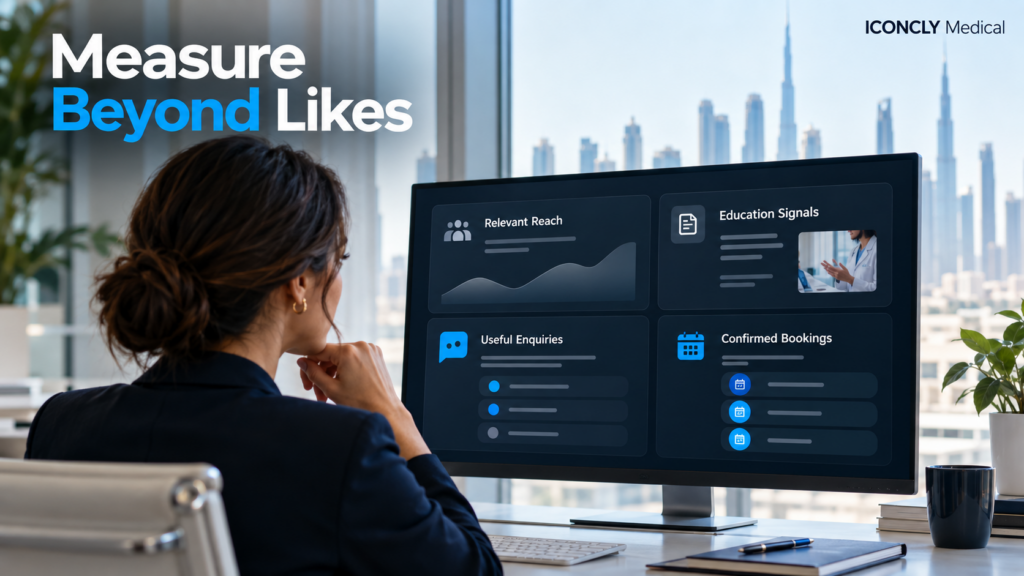
Choose metrics according to the content objective:
| Objective | Useful signals | Practical limit |
| Reach relevant viewers | Reach and video views in the intended market | Exposure does not demonstrate trust |
| Support education | Watch time, saves, and visits to explanatory pages | Engagement does not establish clinical understanding |
| Encourage useful contact | Relevant enquiries and service-page actions | A click is not a conversation or booking |
| Support appointments | Confirmed bookings from traceable enquiries | Attribution may be incomplete |
Use authorised booking records to validate appointment outcomes. Report assisted influence separately from directly attributed enquiries rather than assigning every booking to the latest post.
Interpret low-volume results carefully. A handful of enquiries is not enough to declare that one content format will always outperform another.
Improve the Programme Through Specific Questions
Instead of asking whether the account is “performing well,” ask what each result reveals.
If educational videos receive views but few service-page visits, the next step may be unclear. If service-page visits rise but enquiries remain weak, examine the destination and appointment process. If messages increase but responses are delayed, improve handling before running additional promotion.
Keep a record of changes to topics, calls to action, formats, and destinations. Test a clear hypothesis without changing the entire programme at once.
Connect Social Media With the Wider Medical Marketing System
A useful social programme continues beyond the feed. Social media for doctors provides the content and communication structure, while personal branding for doctors helps keep the clinician’s professional positioning consistent.
Doctor website design gives interested viewers a clear destination for service details and appointment enquiries. SEO for doctors can help that information reach people who independently search for the doctor, specialty, or clinic after encountering social content.
PPC for doctors can support relevant active search demand where the service and campaign meet applicable requirements. Keep each channel’s role and attribution clear, so a connected strategy does not become duplicate claims of success.
Frequently Asked Questions
Which social media platform should a clinic use?
Choose according to the intended audience, communication objective, and production capacity. A patient-facing clinic and a healthcare company targeting professional buyers may need different platforms and formats.
How often should a healthcare organisation post?
There is no universal frequency. Start with a schedule that supports proper review and moderation, then adjust based on useful audience signals and available resources.
Can social media content generate appointment enquiries?
It can support enquiries when it explains a relevant service and connects viewers to a usable contact route. The contribution should be measured rather than assumed.
Does educational content need review?
Clinical claims should be reviewed by an appropriate qualified professional. Administrative information also needs verification so details about access and availability remain accurate.
Turn Your Content Calendar Into a Clear Patient Journey
ICONCLY Medical helps healthcare organisations connect content, authority, and service access. The starting point is identifying what prospective patients need to understand and where the existing journey loses clarity.
Explore ICONCLY’s solutions for clinics to discuss a social media programme with defined priorities, accountable review, and meaningful measurement.